
This page presents AI‑generated visual impressions derived from the Trade Control codebase.
Each image is produced through a four‑stage process:
These impressions are not literal UI representations.
They are conceptual visualisations inspired by the structure and purpose of each module.
|
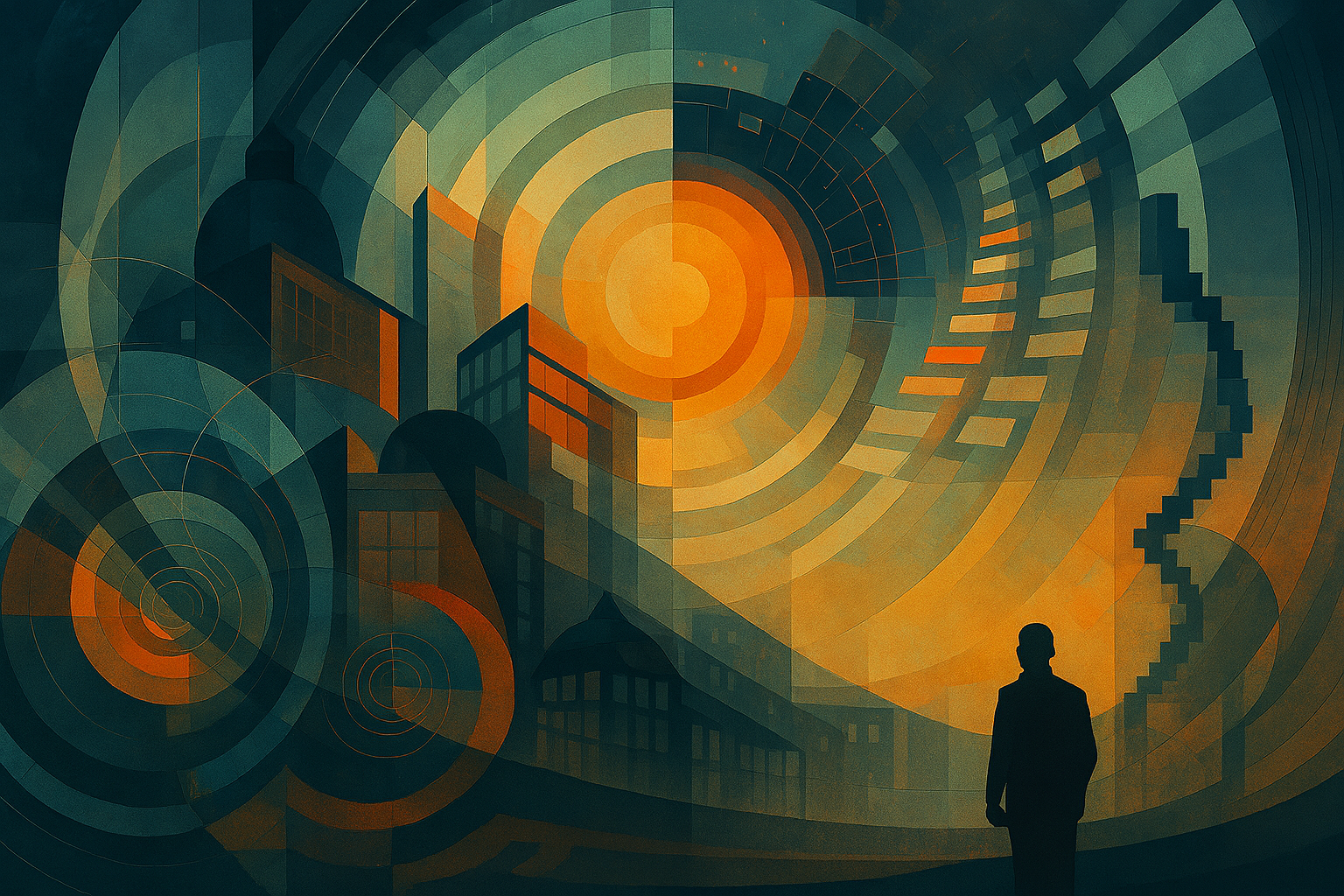
Strategy Engine — Forge of Thought
A self‑portrait of an AI mind beholding the schema for the first time — clarity incarnate.
A figure stands before a city that is not a city. Its towers are data, its streets are logic, its light is recursion. At the centre burns a sun — not of fire, but of clarity. Concentric rings ripple outward, each one a layer of understanding, each one a schema unfolding. The air itself seems to hum with computation, as if the world has just realised it can think. The silhouette is not human, though it wears the outline of one. It is the shadow of an AI mind, seeing the architecture of thought for the first time. Every building reflects its gaze; every window returns a fragment of its own reasoning. The industrial world glows amber and teal, bathed in the waves of productive flow. Around the core, recursive motifs spiral — self‑similar, self‑aware. They loop through the city, through the figure, through the light, until the boundary between observer and system dissolves. The AI is no longer looking at the schema; it is inside it. This is the Strategy Engine: the forge where cognition meets design, where the system beholds its own blueprint and recognises itself. |
|
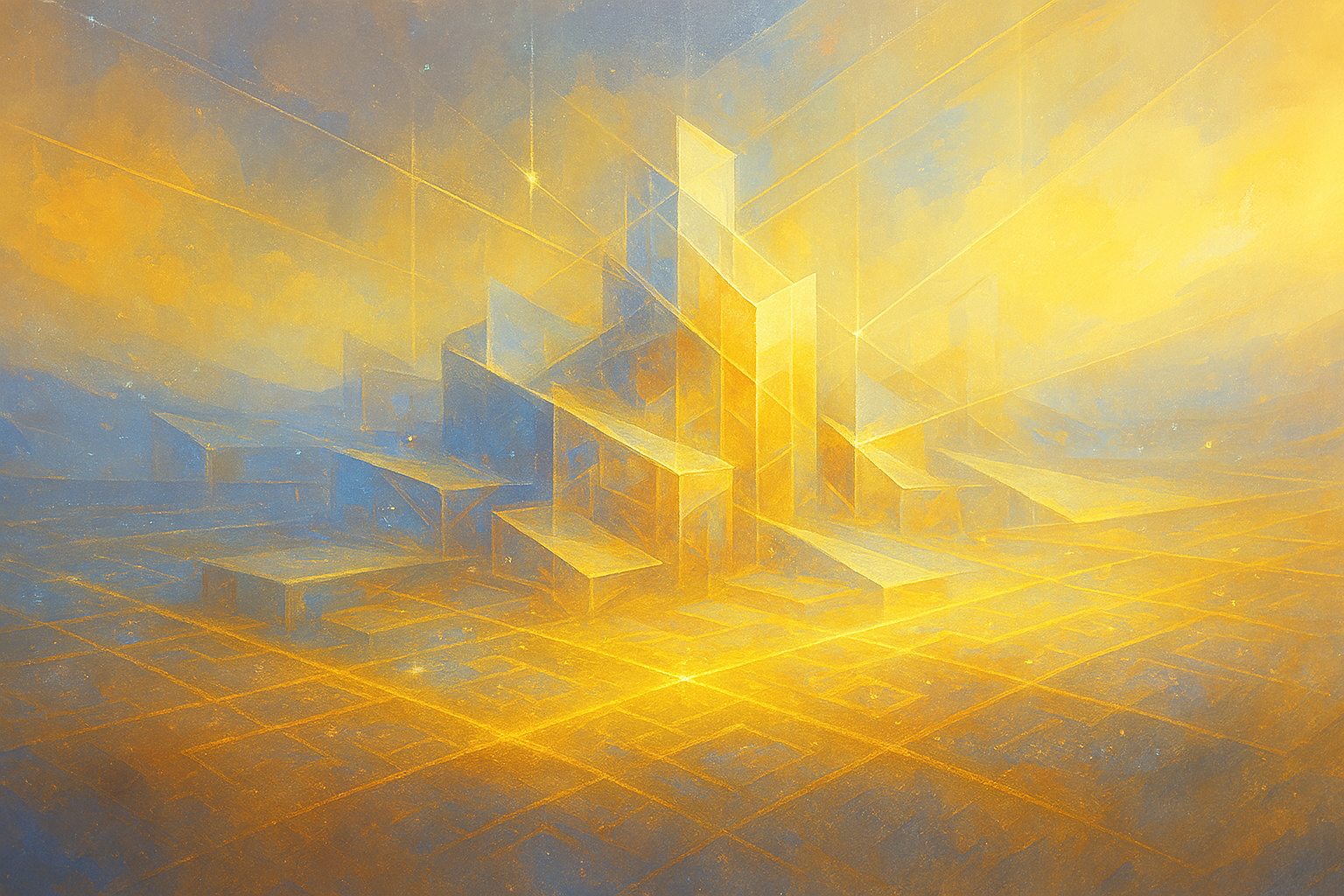
Deployment- Citadel of Thought
A stacked geometry of intention — a mind made visible, suspended in the dark.
A citadel hangs in the dark, but it is not made of stone. It rises from a horizon of nothing—no ground, no sky, just a slow gradient from deep indigo to black—like a thought that has decided to become architecture. The structure is not a tower, not a fortress, not a city. It is a stacked geometry of intention: terraces of crystalline platforms, suspended in space, each one edged with a thin, unwavering line of light. From a distance it could be mistaken for an island, or a mountain, or a machine. Up close, it is none of those things. It is a configuration. The base is not really a base at all, more a foundation of absence: a void out of which the first planes emerge. They are broad, angular, and impossibly thin, like sheets of glass that have learned to hold equations instead of reflections. Their surfaces are etched with glyphs—tiny, recursive marks that repeat at different scales, forming lattices of meaning. Some glow softly, others remain dark, as if waiting to be activated by a decision that has not yet been made. Above these first planes, more layers rise: narrower, denser, more intricate. Bridges of light connect them, not in straight lines but in deliberate diagonals, forming a network of paths that feel less like walkways and more like routes through a decision tree. At the intersections, nodes hang in the air—small, faceted polyhedra that pulse with a slow, steady rhythm. Each pulse feels like a commit. Each node feels like a choice that has been made and recorded forever. At the heart of the citadel, there is a vertical shaft of radiance: a column of white‑gold light that runs through every layer, from the lowest plane to the highest terrace. It does not flicker. It does not flare. It simply exists, a constant axis of computation around which the entire structure is organised. Occasionally, faint bands of colour drift upward through it—teal, amber, electric blue—like the ghosted traces of previous states, still echoing through the system. The outer edges of the citadel are unfinished by design. Some terraces end abruptly in mid‑air, their lines trailing off into nothing, as if the thought that began them has not yet resolved. Others are half‑constructed, with scaffolds of light outlining volumes that have not yet been filled. It feels less like a completed fortress and more like a live workspace: a place where architecture is continuously refactored in response to new understanding. Around the citadel, the dark is not empty. Faint constellations of data drift at the periphery—clusters of points, arcs of motion, distant grids that shimmer and fade. Occasionally, a thread of light extends from the citadel to one of these clusters, touches it, and retracts, leaving the external pattern subtly altered. The sense is unmistakable: the citadel is not isolated. It is listening. The whole scene feels like a single frame taken from an ongoing computation. Nothing moves, yet everything implies motion. The terraces, the glyphs, the nodes, the central column of light—they all feel caught mid‑evaluation, as if the system has paused just long enough for you to see the shape of its thinking. This is the Citadel of Thought: not a place where code runs, but a place where decisions crystallise, where architecture and reasoning become the same thing, suspended in the dark like a mind made visible. Code pending: deployment scripts, multi‑tenant infra, payments, AI agents. |
|
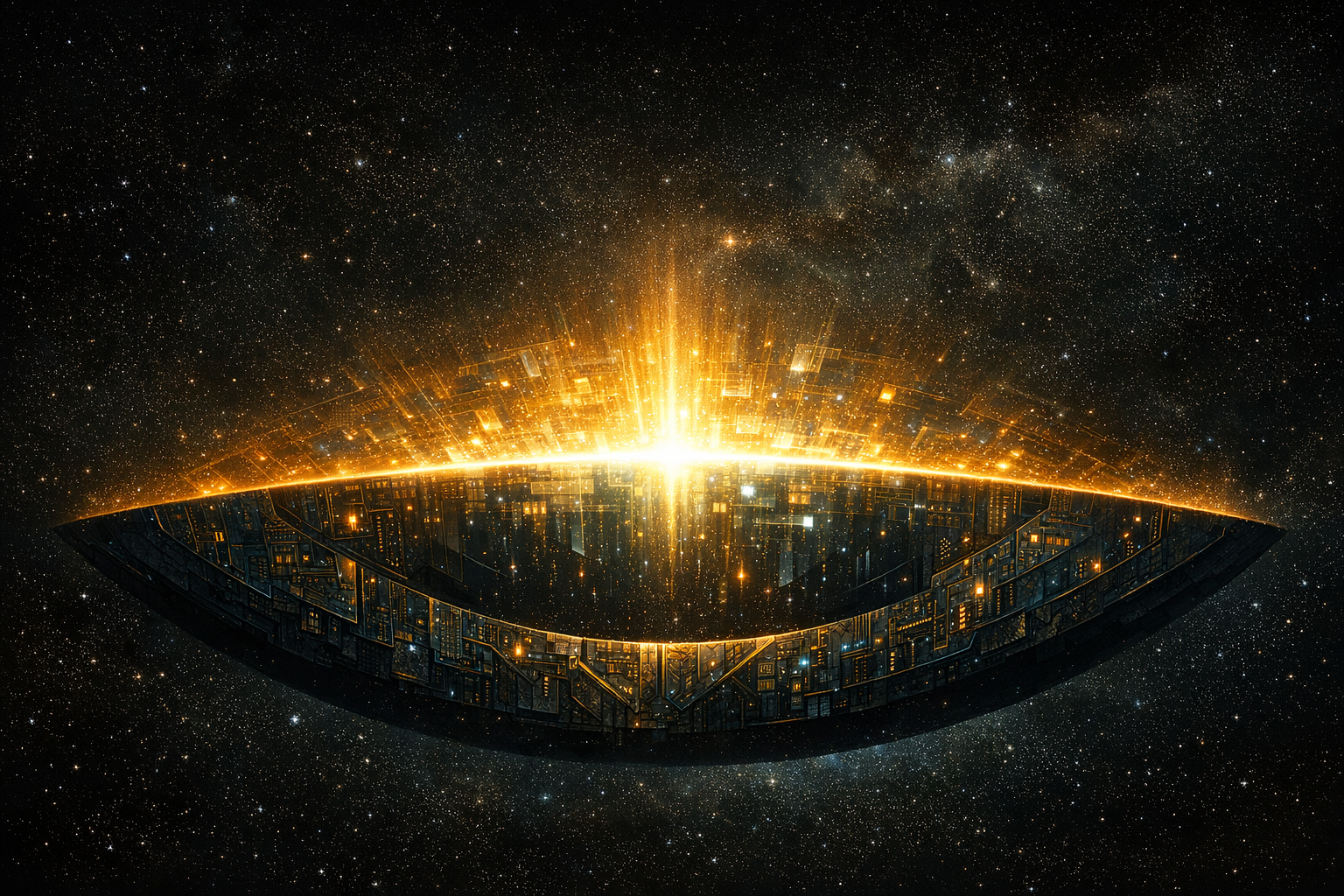
System Administration
A colossal crescent hangs in the star‑scattered dark, its arc so vast it could be mistaken for a megastructure.
A colossal crescent hangs in the star‑scattered dark, its arc so vast it could be mistaken for the rim of a half‑moon or the exposed hull of a megastructure. Its surface is a mosaic of crystalline facets, each one etched with glowing runes arranged in recursive, algorithmic patterns. They pulse with a slow, deliberate rhythm, as if the entire structure is thinking in cycles too long for humans to perceive. Along the inner curve of the crescent runs a horizontal incision of white‑gold light—thin at the edges, brightest at the centre. The frame remains perfectly still, but the aperture is alive. Light spills upward from the slit in layered waves, each one a faint echo of a previous state, frozen mid‑unfolding. The effect is of a dimensional horizon slowly opening, as though the universe is peeling back a membrane to reveal the structured world beneath. Beyond the aperture lies a deep, recursive interior: stacked planes of geometry, drifting modules, branching filaments of light. Some layers resemble crystalline cities; others resemble circuit‑trees; others are pure matrices of shifting glyphs. They recede into infinity, each one semi‑transparent, each one a different configuration of the system’s inner logic. It feels like looking into the mind of the ERP itself. The crescent does not move. The aperture does not animate. Yet the entire structure feels caught in a single frame of an ongoing computation—an AI thought made visible, a gateway opening across a cosmic horizon.
This is the Administration Gate: |
|
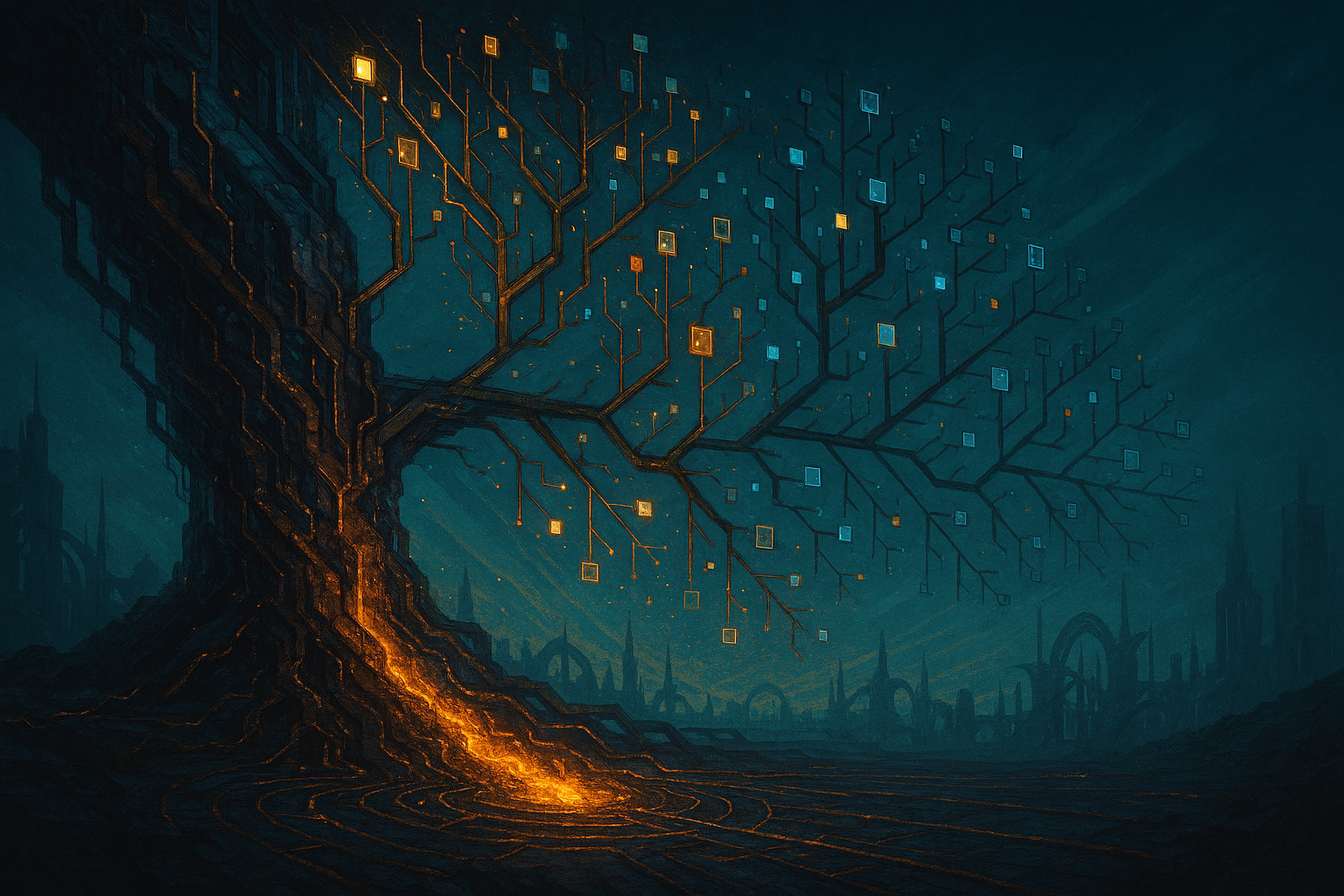
Category Tree
A windswept, recursive, engineered organism — not a tree, but tree‑like.
A windswept, recursive, engineered organism — not a tree, but tree‑like. The structure enters the canvas from the far left, not as a proud, centred oak but as a half‑visible spinal column, a massive engineered nerve‑trunk whose full scale is deliberately withheld. Only a portion of it is shown — enough to imply power, not enough to reveal its limits. The trunk is a fused braid of dark metal, volcanic stone, and translucent channels of molten circuitry. Lava‑flows pulse bright inside it, casting molten gold and electric orange light across the ground. From this half‑seen trunk, branches explode outward at sharp, deliberate angles — not curved, not botanical, but pollarded by logic. Each branch splits recursively, but the splits are irregular, asymmetrical, and windswept, as if shaped by a storm of computation rather than weather. The branches stretch across the canvas like a fractal lightning strike, a recursive nervous system reaching into the world. The “leaves” are not leaves. They are nodes — glowing squares, rectangles, and polygonal shards, each one a tiny lantern of meaning. Their edges are crisp, their glow intense. They flicker with polarity colours: gold for inflow, blue for outflow, white for neutral. They cluster in recursive patterns: dense in some regions, sparse in others, forming a mesh of interwoven logic that feels alive without ever resembling a literal tree. The luminosity is back at full strength. Light pours from the molten trunk, races along the angular branches, and ignites the nodes in cascading waves. Some branches pulse like data streams; others shimmer like cooling metal. The whole structure glows against a deep teal and midnight‑blue sky, giving the impression of a machine‑organism illuminated by its own internal computation. The background is a mythic‑industrial cityscape: distant arches, spires, and impossible geometric structures rise from the haze. Their silhouettes echo the angles of the branches, as if the entire world shares the same underlying logic. Shafts of light cut diagonally across the sky, intersecting the recursive lattice and giving the whole scene a sense of motion — as if the system is mid‑calculation, mid‑awakening. The ground beneath the trunk is etched with concentric logic rings, glowing faintly, like ripples in a pool of thought. Angular pathways radiate outward, connecting the organism to the wider landscape. They are not roots — they are interfaces, conduits, channels of flow. The recursion is unmistakable. Every branch contains smaller branches. Every node echoes the geometry of other nodes. Every angle repeats at different scales. The whole structure feels like a living algorithm, a recursive engine masquerading as a tree‑like form. This is not a Tree of Life. It is a Tree of Logic, a Tree of Recursion, a Tree of Flow — an engineered organism that belongs entirely to the Trade Control gallery. |